
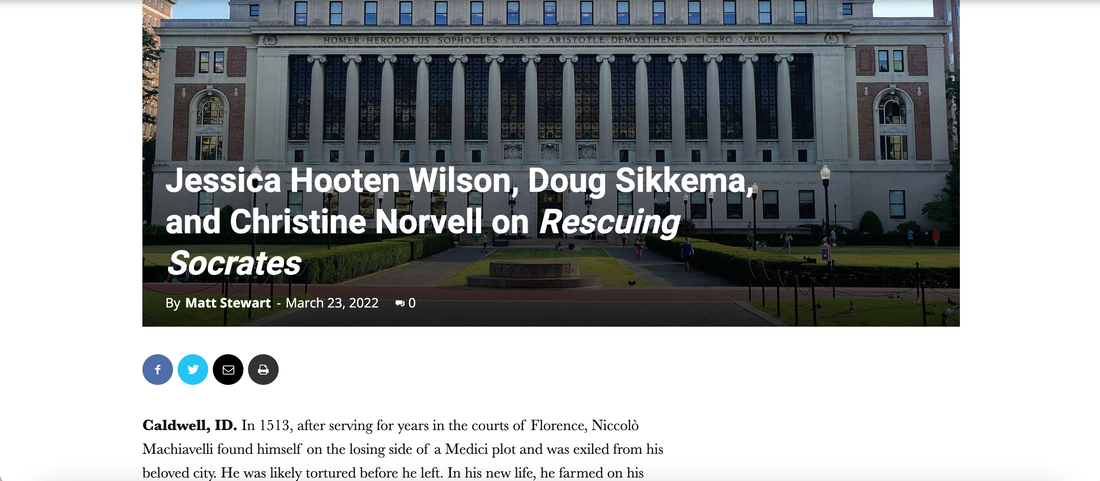
 Caldwell, ID. In 1513, after serving for years in the courts of Florence, Niccolò Machiavelli found himself on the losing side of a Medici plot and was exiled from his beloved city. He was likely tortured before he left. In his new life, he farmed on his family estate and spent his days debating peasants in the local inn. But that was not all. He described the rest of his day in a remarkable and justly famous letter to his friend Francesco Vettori:
When evening comes, I return to my home, and I go into my study; and on the threshold, I take off my everyday clothes, which are covered with mud and mire, and I put on regal and curial robes; and dressed in a more appropriate manner I enter into the ancient courts of ancient men and am welcomed by them kindly, and there I taste the food that alone is mine, and for which I was born; and there I am not ashamed to speak to them, to ask them the reasons for their actions; and they, in their humanity, answer me; and for four hours I feel no boredom, I dismiss every affliction, I no longer feel poverty nor do I tremble at the thought of death: I become completely part of them. Roosevelt Montás, the author of Rescuing Socrates, was likewise welcomed kindly into these ancient courts after finding a whole set of Harvard Classics in the garbage and—due to limited space for books in the Queens apartment of his teen years—saving the Plato volume from suffering the fate of the rest of the series. Like Machiavelli, he is also unashamed to speak with the ancient men and to question them. His new book is a generous and magnanimous account of his own initiation into the world of classics via the Columbia College Core Curriculum, as well as a thoughtful record of his continued engagement with them in many classrooms at Columbia and elsewhere....
0 Comments
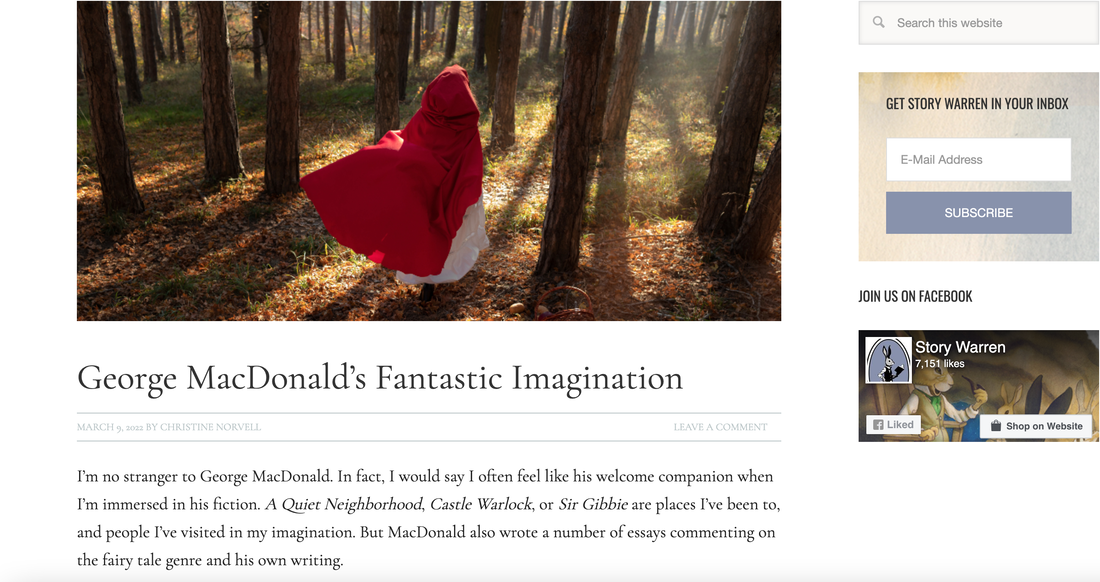 I’m no stranger to George MacDonald. In fact, I would say I often feel like his welcome companion when I’m immersed in his fiction. A Quiet Neighborhood, Castle Warlock, or Sir Gibbie are places I’ve been to, and people I’ve visited in my imagination. But MacDonald also wrote a number of essays commenting on the fairy tale genre and his own writing.
In “The Fantastic Imagination,” MacDonald clarifies that fairy tales really have nothing to do with fairies, or at least they don’t have to. They do, however, have a “natural law” unto themselves as MacDonald writes. Our imagination won’t work without it. This is what he means. When we create from our imaginations and write a story, we naturally follow a pattern of harmony. MacDonald explains it this way: If you were to give a bizarre accent to “the gracious creatures of some childlike region of Fairyland,” then wouldn’t the tale sink then and there? The pieces of the tale must harmonize and not stick out... 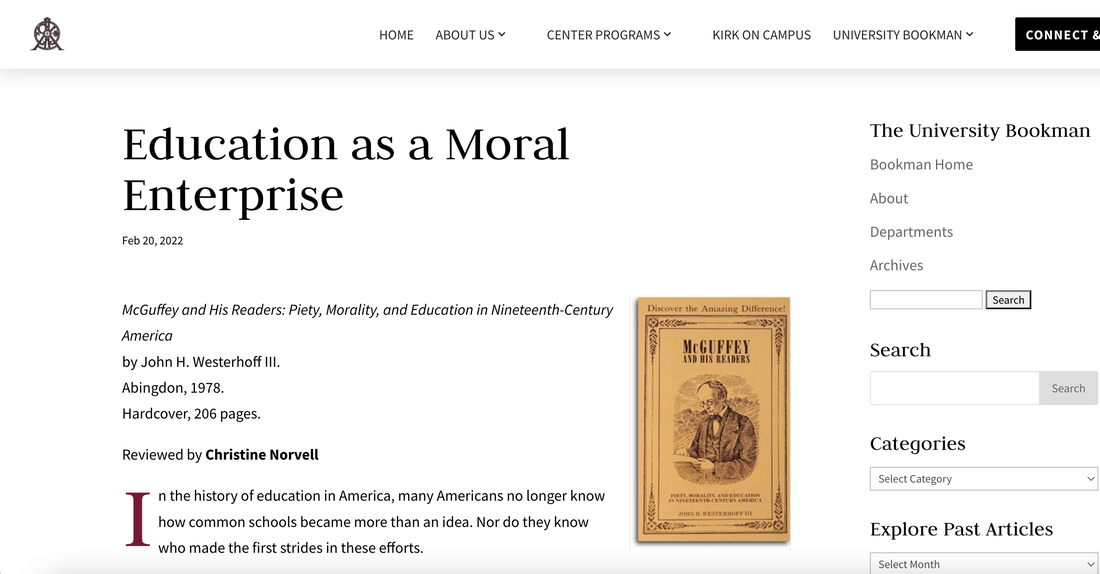 In the history of education in America, many Americans no longer know how common schools became more than an idea. Nor do they know who made the first strides in these efforts.
Thomas Jefferson attempted to establish a decentralized public school system more than once, a plan based on localized districts within counties. In his 1778 “Bill for the More General Diffusion of Knowledge,” he stressed the need for vigilant citizens who would constantly be on guard against the ambition of rulers, especially at the state or federal levels. Jefferson wanted to educate all students as future citizens in a republic and at the same time provide expanded opportunities for men to develop into the future political leaders of Virginia. At his 1838 Lyceum Address in Springfield, Illinois, Abraham Lincoln advocated that schools should teach a reverence for our American democracy: “Let reverence for the laws be breathed by every American mother, to the lisping babe, that prattles on her lap—let it be taught in schools, in seminaries, and in colleges; let it be written in Primers, spelling books, and in Almanacs;—let it be preached from the pulpit, proclaimed in legislative halls, and enforced in courts of justice. And, in short, let it become the political religion of the nation.” Building on this idea of citizenship, William Holmes McGuffey (1800–1873) strove to openly cultivate Christian character by developing readers in the growing American West independent of British influence. The McGuffey Readers introduced students to the classics, to morality, and to good character. Seven million readers were sold before 1850 with thirty-seven states adopting them by 1890. McGuffey’s influence held for decades. In his examination of McGuffey’s life and curriculum, John H. Westerhoff weaves a biography within a fascinating history of education in the early 1800s. The idea of common schools was growing. Westerhoff’s research clearly shows how McGuffey and his original Readers made a significant impact on nineteenth-century education through the use of moral teaching, civics, story, and phonics....  Long ago I took an undergrad course titled Oral Interpretation of Literature. I needed two speech classes to graduate with my education degree, and it happened to fit my schedule. I had no idea what I was walking into. I didn't know that a drama professor taught it. Like myself, most of the students were education majors thinking we had found an easy class to balance out our heavier ones. No textbook required. Our first assignment was to take turns standing in front of the class to read “Dover Beach.” We were to read aloud and keep eye contact. What we didn't know was that we would be excoriated for everything from enunciation to volume to facial expression and posture. It was eye-opening to say the least. I had no expectations. But Professor Lewandowski did. Within two weeks I had two Cs and I was proud of them. Professor Lew promptly coached us as he would an actor presenting a monologue, yet he told us the class was not about drama. Everything we said was about expression, the value of words. He thought that teachers could perform not for performance’s sake, mind you, but because that was how you appreciated the words you said. He reminded us that we would have a captive audience every day of the week in our classrooms after all.
Every other week we presented a poem, a passage from a novel, or a bit from a short story or a play. We learned from each other's mistakes, but we also learned from each other's presentations. And by presentation I mean that moment of beauty when the words, the volume, and the expression create a moment of beauty for the audience, a moment of awe. After presenting four times in class, I still had a C. I was dumbfounded because I was trying my hardest. So I finally stayed after class and asked for help. I wanted to figure out this riddle, this thing I didn't understand how to do. He spent ten minutes helping me polish one section of Rossetti’s “Goblin Market,” just one. But it was enough. After all these weeks, this little bit of practice and coaching was what I needed. By repetition, he taught me in those moments to read the lilt in the Rossetti’s rhyme, to play with different words. I don't remember if I got an A or a B by the end of the semester, but I do remember improving, performing a section of Leo Tolstoy's “The Death of Ivan Ilyich.” It was a challenge, but I tried and performed, reading and engaging the audience, and using the tools Professor Lew had shown me. I may have done a decent job. After all these years, decades, I still have a file of notes from that course. I have not forgotten. But more than that, I know interpreting the literature and poetry I teach adds everything to how my students hear. I only hope that my efforts lead my students to the same wonder I experienced at age 19.  Sometimes I reread children’s literature because I enjoy being captured again by the quality of writing and the stir of imagination. I read Laura Ingalls Wilder alongside every Louis L’Amour western in my junior high library. Not one librarian said I couldn’t read them because I was a girl, and thankfully, those same librarians pointed me next to Zane Grey. At age 13 and 14, these westerns were deep to me, even if I did recognize the plot patterns. I loved them. Action, mystery, rescue, the setting sun, the lonely West, and often, a misunderstood man.
In the same vein, Jack Schaefer’s very first novel creates a story that’s even more impactful. Shane (1949) began as a short story that was serialized in three parts in Argosy magazine in the late 40s. First titled “Rider from Nowhere,” it wasn’t intended for young children, though it’s certainly suitable. Through the eyes of a child narrator and from his opening description, Schaefer crafts a deeper cowboy character than most, perhaps because we witness Shane’s moral choices and his influence upon an entire family... 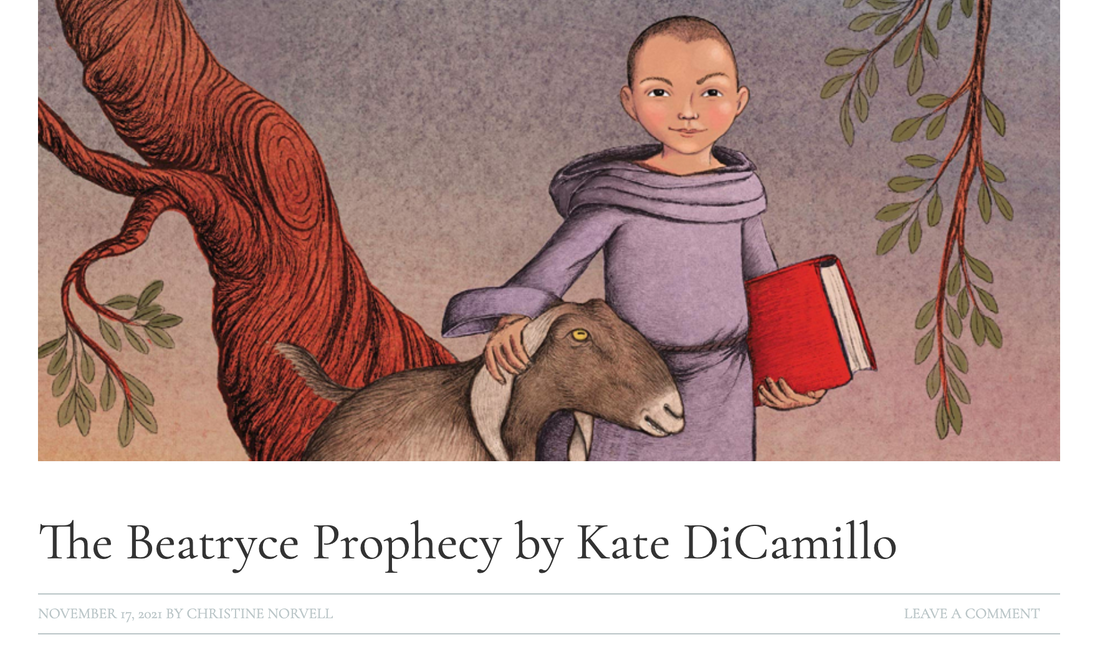 The world is not always a kind place, said Brother Edik.
We may lose those we love along the way, but unexpected friends, like a goat, can bring delight and comfort. Yes, a goat. In Kate DiCamillo’s The Beatryce Prophecy, the monks of the Order of the Chronicles of Sorrowings are harassed by an ornery goat, one that soon finds a different purpose in comforting a lost girl. Beatryce is found by Brother Edik, who long ago foretold that a girl child “will unseat a king.” But Beatryce doesn’t remember why she fled her home. She doesn’t know she might be important. “Will you write of this in the Chronicles?” she asked. “Will you say that a girl named Beatryce, who does not know where she came from or who her people are, held on to a goat and sorrowed?” “Yes,” said Brother Edik from above her. “It will be written so.” “As something that happened?” said Beatryce. “Or as something that has yet to happen? Will I become a prophecy?” “Oh, Beatryce,” said Brother Edik.  I’ve made huge lists of everything I’ve done in my short life. I’ve accomplished so much, and I can show you my work, says Solomon.
It’s too familiar. Lists have been a lifeline for me as a working mom, a salvation of things that would have been forgotten. I’ve accomplished so much, I think. I remembered to buy peas and Band-Aids at the store. I signed and sent the weekly reading logs to school with my sons. I vacuumed one bathroom. So, I pat myself on the back, taking pride in the accomplishment of one day. But does checking things off mean something? It might be encouraging at that moment, for that day, but weeks and months from now, will it mean anything? After all, Solomon darkly reminds us that man takes nothing with him at death (Ecclesiastes 5:15)....  I enjoyed a unique phone call recently. One of my former students reached out for help with a long essay. As a hopeful history major, Eric wanted to submit a college application essay on a historical subject he loved—the French Revolution. He had narrowed the topic to the role of Royalist journalists and had completed all of the research, including some amazing digitized letters and propaganda from that time period. Unfortunately, the essay had practically become a list of quotes and sources and key figures. Some connections among them had been made, but it wasn’t coherent. Yet. We circled back to his premise, and I asked, “What is your point? What are you leading us to understand?” That helped a little bit, but Eric said he needed more time to think about it. So of course I asked him to revise it further, and he immediately asked, “What does that word mean?” Good question. From Latin and French roots, revise means to look at or look over again. It sounds horribly simple: By the 1590s, revise came to mean "to look over again with intent to improve or amend."* But that doesn’t help the student know what to do. They understand by context that they must make corrections. These are the concrete elements, the checklist, the things the teacher may have noted like “add a transition phrase here” or “choose a stronger verb” or “check for commas.” This is editing, not rewriting or revising. But Eric had moved beyond concrete editing already. As teachers, we have to remember that we are both readers and writers. If we instruct in writing, it’s because we read first. In God in the Dock, C.S. Lewis reminds us that “The reader, we must remember, does not start by knowing what we mean. If our words are ambiguous, our meaning will escape him. I sometimes think that writing is like driving sheep down a road. If there is any gate open to the left or the right, the reader will most certainly go into it.” And that compelled me to ask Eric a few questions: How can you make your writing more clear? Is there a sentence or thought that obscures or leads you away from what you really mean to say? If you were an editor of a historical journal, what would you cut as excess?” In this instance, it was a fruitful exercise. He immediately cut several “interesting” facts that did not lead to his real point—the Royalists believed revolution was sin because they were preserving the semblance of Jesus Christ, King Louis XVI. Eric eliminated four sentences in four pages. He told me it was easier to see once I mentioned that sentences can lead away as well as lead us to the premise. It may not seem like a lot, but by removing them, he could more easily see what needed to be connected.
I hesitate to use the phrase “big picture,” yet I would ask if we can see the essay as a whole. Can we see our way in the forest through the leaves of words or has the path been obscured? Before, fascinating tidbits led Eric into the weeds and fields beside the path. By eliminating what led him away, he gained the path again. Each fact, each quote, each sentence connected his journey along the path of the essay. And seeing might be the point of revision, to re-vision our thoughts. *Online Etymology Dictionary  I received a rejection last week. From one year ago. An agent whose work I admire had requested a full manuscript for my middle grade novel. I enjoyed the read – you’ve got a great voice here, and I really liked the concept, but in the end, I just didn’t fall enough in love to be able to offer representation.” For those in the writing trenches, you’ll recognize the wording of a standardized rejection. It’s neither encouraging nor discouraging. From an agent, it could mean “Your story is not for me” or they (or their assistant) really weren’t captured enough to read it, let alone provide feedback.
Rejection is an odd thing for me as a literature teacher because I delight in words. Reading, absorbing, experiencing, teaching, analyzing, writing. As a teacher, I hope to never suck the joy out of the reading experience for my students. I certainly endured more than one class in high school and college that did that well. Analyze. Pull the story apart. Pick it to death. Put it back together. Mash it into the meaning the teacher wants. Textbooks can often be structured that way too. I wonder if many are built for overworked teachers, to make their lives easier. They might include commentary on a theme, different levels of discussion questions, and ideas for essays. Sometimes I’d rather they didn’t. It can be too prescriptive because the textbook authors are giving you their meaning. On the surface, it’s like saying that teachers and students alike are incapable of thinking through these things. It’s practically miraculous that any student comes out of that system having enjoyed the story still. And that’s the odd parallel. In writing fiction, I have to be aware of all of the parts, like ingredients in a recipe. I know what I’m making, but every separate thing must come together. I have to be intentional. I have to be aware of word choice, lexile, backstory, setting, point of view, tone, characters’ needs and wants, the arc of each character, the arc of the plot, scene structure—so many things. It’s the opposite of how I read and how I teach reading and writing. I realize now that I most appreciate a holistic approach. I do think all of the parts come together as a whole, a synchronicity of sorts. For some writers it comes naturally. For others, like me, it comes through labor and training, especially through the imitation of others. And that gives me every hope that as I teach my students parts of the whole, I can do it in a way that doesn’t suck the joy out of the reading experience. We don’t have to notice absolutely every thing in a story to enjoy it. As I lead a class, I can model that. I can choose to emphasize perhaps two or three things an author has constructed. As I am aware, even hyper aware of what an author has done in the story structure, I am able to encourage my students to appreciate the grand design.   I love a good mess. Over the past week, two handymen have been working on our house, replacing rotted siding and a handful of windows. They have touched almost every room in our house for one reason or another and tend to leave funny little bits behind. As I’m writing this at my bedroom desk, I can see a small plastic package of unopened screws left on my desk. If I walk into my bathroom, I find a new package of long brass wood screws. If I toodle over to my husband’s office, I can see a red-handled wood chisel sitting high up on an upper window sill. Every room has something left behind, or, if I look at it in another way, a tool or supply for equipping us in our repairs. Perhaps it’s more than home repairs because repairs make me think of one book I’ve slowly ingested this summer--Madeline L’Engle’s Walking on Water: Reflections on Faith and Art (1980). You see, in the writing game, I fight discouragement regularly. I fight doubt, purpose, all those things. L’Engle does not deny the negatives and speaks candidly about her “decade of failure” where doubt and guilt consumed her with “bitter lessons” in her writing journey. Her compilation of thoughts on the process of writing amid reflections on her spiritual life has become a nourishing devotional to me in the summer season. We think because we have words, not the other way around. The more words we have, the better able we are to think conceptually." L’Engle consciously turns her focus to how God works through us. “But we also need to be reminded in this do-it-yourself age that it is indeed God who made us, and not we ourselves. We are human and humble and of the earth, and we cannot create until we acknowledge our createdness.” She explores many tangents along the way but always returns to “An artist is a nourisher and a creator who knows that during the act of creation there is collaboration. We do not create alone.” I’ve copied many of these quotes in my writing journal this summer, writing them down over and over. It’s like the life of L’Engle’s words have become my cheerleader, bringing me back to center. When I am constantly running there is no time for being. When there is no time for being there is no time for listening.” And I do want to listen as I read and write. I don't want writing to become my busyness. To repair is to mend and put back in order. But its Latin root parare means to make ready, to prepare. I trust that I am “making ready” again, preparing for the life where my words fit in the homes God has for them. 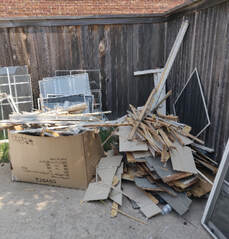 |
 RSS Feed